01
One island per week
São Miguel is the easiest first visit. Add Terceira for baroque cities, or Pico + Faial together for wine and whales. Nine islands in one trip is nine wasted flights.
Volume XIII · Açores
Seven chapters. Green craters, wine grown in black volcanic pens, the only tea plantation in Europe, and a stew cooked underground by the earth itself.
Curated by Édi Cruz
Açores · 2026
Blue hydrangeas line every road on São Miguel. The wine of Pico grows in black volcanic pens the size of a bed. In Terceira, thirty-eight small painted chapels wait all year for the Holy Ghost. You cannot say Portugal in the singular here.
Every island is different. São Miguel is green and volcanic — hot springs, crater lakes, tea plantations. Terceira is baroque cities and Espírito Santo festivals. Pico is a black-lava wine country cut by hand-built stone walls. Faial is where transatlantic sailors leave their boats' names painted on the harbour wall.
Come for a week per island. Bring waterproofs. Do not expect the weather to obey a forecast.
For Portugal, with love.
This guide is free. Always.
The Açores are three archipelagos, not one. Choose your islands.
São Miguel is the easiest first visit. Add Terceira for baroque cities, or Pico + Faial together for wine and whales. Nine islands in one trip is nine wasted flights.
You will have sun, fog, and rain in the same afternoon. Carry a waterproof, a warm layer, and something for the sun. Every day.
Roads are steep and often wet. On São Miguel and Terceira a normal car is fine; on Pico or Flores something with a bit of grip helps.
The cozido — the stew cooked underground in the caldeira — has to be buried at 6am. Restaurants take orders the day before. Confirm with WhatsApp.
The plantation on the north coast of São Miguel has been growing tea since 1883 — the only working tea estate on the continent. Free visit, small shop.
Sperm whales, blue whales, pilot whales, orcas. Trips leave from Ponta Delgada and from Lajes do Pico. Pick a small-boat operator, not a catamaran.
Pico's white wine, grown in tiny walled plots of black basalt, is nothing like anything on the mainland. Volcanic, mineral, salt-air. €8 to €15 a bottle.
In Furnas, on São Miguel, the volcano still cooks lunch. There is no other kitchen quite like it.
 N° 01
N° 01© Navin75 · CC BY-SA 2.0 · Wikimedia Commons
São Miguel · Furnas
FoodBeef, chicken, pork, chouriço, morcela, potato, cabbage, carrot — all layered into a metal pot, sealed, then buried at 6am in one of the geothermal holes beside Lagoa das Furnas. Cooks for six hours in the steam of the earth. Served at 1pm in the restaurants of Furnas village. Book the day before.
One plantation, one leaf, one small green story that Europe forgot.
 N° 01
N° 01© Lizard Graphics · CC BY-SA 3.0 · Wikimedia Commons
São Miguel · Gorreana
TeaSince 1883 the Gorreana family has grown, picked, and processed tea on the wet north slope of São Miguel — the only continuous tea plantation on European soil. Free visit, ten-minute self-guided tour of the pre-industrial machinery, and a small tea room at the end. Bring cash for a tin.
Terceira is a small island that built a UNESCO city and thirty-eight tiny painted chapels for the Holy Ghost.
 N° 01
N° 01© Diego Delso · CC BY-SA 4.0 · Wikimedia Commons
Terceira · Angra do Heroísmo
CultureThe 16th-century cathedral of Angra do Heroísmo, the first city ever declared a World Heritage Site (1983). Massive twin bell towers, whitewash and black basalt trim — the colour palette of every Azorean building since. Free entry.
 N° 02
N° 02© Vitor Oliveira · CC BY-SA 2.0 · Wikimedia Commons
Terceira · Serreta
CultureEvery parish in Terceira has an 'império' — a tiny chapel painted in a different colour, used once a year for the Festa do Espírito Santo. This one, in Serreta, is pale blue and gold. Drive the north road slowly. Photograph them all.
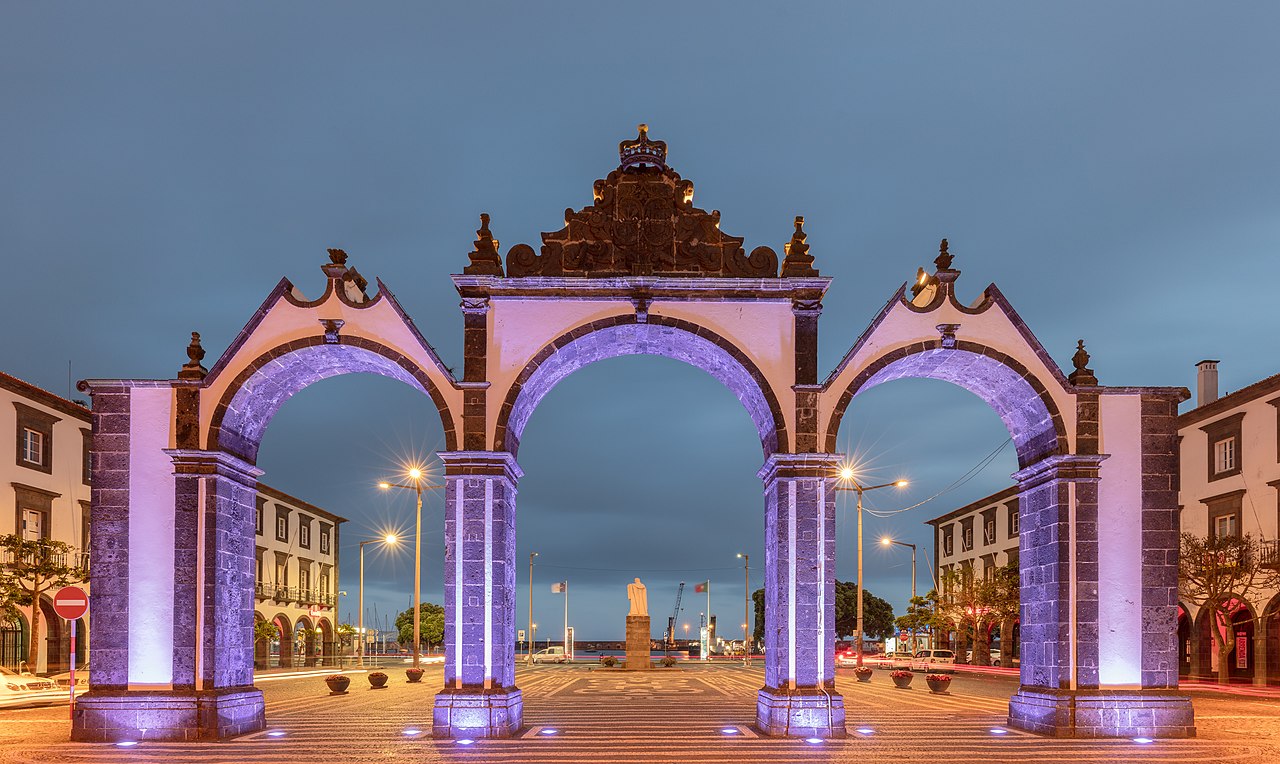 N° 03
N° 03© Diego Delso · CC BY-SA 4.0 · Wikimedia Commons
São Miguel · Ponta Delgada
CultureThe three black-basalt arches on the Ponta Delgada waterfront — the ceremonial gate that welcomed every ship for four centuries. Now they open into a paved square with cafés on both sides. Start any walk of the city here.
Two panoramas that make people forget to speak.
 N° 01
N° 01© The Cosmonaut · CC BY-SA 4.0 · Wikimedia Commons
São Miguel · Serra de Água de Pau
ViewpointThe 'Lake of Fire' — a green crater lake inside a green crater ring, protected as a nature reserve. Park at the miradouro on the north rim and walk fifteen minutes down to the black-sand shore. No boats, no houses, no sound. Absolutely no drones.
 N° 02
N° 02© Jetsettr20 · CC BY-SA 4.0 · Wikimedia Commons
Pico · São Mateus → Lajes
ViewpointOn Pico island, the Verdelho vines grow in thousands of tiny hand-built black-basalt walled plots (currais) — protected as a UNESCO cultural landscape since 2004. Drive the south coast from São Roque to Lajes. Stop at a wine cooperative. Try the Verdelho and the Terrantez.
 N° 03
N° 03© Gonçalo Torres · CC BY-SA 4.0 · Wikimedia Commons
São Miguel · Sete Cidades
ViewpointNot the famous view from above — the village down inside the caldera, a whitewashed hamlet on the neck of land between the Green Lake and the Blue Lake. Drive down from the ridge, walk to the little chapel, look up at the crater walls all around you.
