01
Rent a car
There is no other honest way to see the Ribatejo. The villages are 20 minutes apart and the buses do not care.
The Long Letter · Ribatejo
Eleven chapters. The country I return to when I need Portugal to remind me who she is.
Curated by Édi Cruz
Ribatejo · 2026
Everyone knows Lisboa. Fewer people know that if you drive one hour north-east, cross the Tagus, and keep going into the low green hills, you enter a Portugal that has quietly been herself for a thousand years.
This is the Ribatejo. Two great rivers — the Tagus and the Zêzere — carve through the province. The soil is generous, the horses are famous, the wine is old, and the pace is deliberate. It is not glamorous. It is not on any influencer's list. It is my favourite place in my own country.
I have walked these villages and river banks over many months. Take your time with the pages. Do not try to see everything — that is not how the Ribatejo works. Pick two or three places, spend a whole afternoon, eat wherever smells right, and let the country slow you down.
The Ribatejo asks nothing of you except that you notice. If you can do that, she will give you back a piece of Portugal that most travellers never touch.
For Portugal, with love.
This guide is free. Always.
In this letter
The Ribatejo is a slower country. Meet her at her pace and she will meet you at yours.
There is no other honest way to see the Ribatejo. The villages are 20 minutes apart and the buses do not care.
A small café on the Tagus at 8am, a coffee, a piece of bolo do caco. The whole province is different after that.
Then it reopens at 3. This is not a bug — it is the culture. Learn to nap.
The best place to swim, the best restaurant, the best sunset — all live in the head of the man selling melons at the roadside stall. Buy a melon, then ask.
Bordalo, achigã, lampreia when it's in season. This is a river country before it is anything else.
Park at the edge, walk in. Every village has one square, one chapel, one café — and one story worth staying for.
The Tagus and the Zêzere both turn copper at the end of the day. The Ribatejo's sunsets are quieter than the Algarve's — and more moving.
Ribatejo wine is honest and cheap and made by people who will remember your name. Skip the shop, drive to the winery.
One weekend is a taste. Two visits, in different seasons, is the whole education.
“This is where I come when I need Portugal to remind me who she is.”
— Édi
Ribatejano food is old, honest, and generous. This is bread-country and river-country, cooked without hurry. Come hungry.
 N° 01
N° 01© Jrobal0 · CC BY-SA 4.0 · Wikimedia Commons
Tomar
RestaurantA modern-classical kitchen inside a stone Tomar townhouse. Ribatejano ingredients treated with a straight-backed respect.
Price
€€€
Best time
Weekday lunch
Duration
2½ hours
White walls, dark wood, a small courtyard. The kind of dining room where a conversation stretches.
For proof that traditional Ribatejano cooking, done seriously, is world-class.
 N° 02
N° 02© GualdimG · CC BY-SA 4.0 · Wikimedia Commons
Tomar
RestaurantAn inn on a small island in the middle of the Nabão river, with tables set out under the plane trees. The river is under your chair.
Price
€€
Best time
Late lunch — 2pm
Duration
About 2 hours
Green light on water, the sound of a mill wheel still turning nearby, ducks that expect a piece of bread.
Because the setting alone would be enough — but the fish is also faultless.
 N° 03
N° 03© Adriao · Public domain · Wikimedia Commons
Alpiarça
RestaurantA family adega where the wine is served from a barrel and the food is whatever the mother made that morning. There is no menu — she comes to the table and tells you.
Price
€
Best time
Sunday lunch
Duration
2 hours
Whitewashed walls, wooden benches, the smell of woodsmoke from the outside oven.
For the most Ribatejano meal you will ever eat. Nothing here comes from a supplier — everything from within 5km.
We do not publish photographs of places we have not verified.
Coruche
RestaurantA grilled-meat house in the cork-oak country. The chef cures his own pork, grows his own herbs, and once told me that he does not trust anyone who eats fast.
Price
€€
Best time
Weekend dinner
Duration
2 hours
Old rustic dining room, a fireplace in winter, a shaded terrace in summer.
Because Ribatejano pork — from the black pigs that roam the cork oaks — is one of Portugal's quiet wonders.
 N° 05
N° 05© Chedlund808 · CC BY-SA 4.0 · Wikimedia Commons
Santarém
RestaurantIn the old part of Santarém, a stone-vaulted taberna serving small plates of Ribatejano classics. The wine list is a love letter to the province.
Price
€€
Best time
Dinner
Duration
1½ hours
Candlelight, low arched ceilings, the murmur of locals eating quietly.
For a first taste of the province if you have only one evening. Order six small plates and one big bottle.
“The best restaurants in the Ribatejo are the ones where the owner does not sit down.”
— Édi
Every Ribatejano town still has its old café — marble counter, a radio, three or four men who have been there since 7am. Sit down. Order a bica. Do not check your phone.

© Fmramos89 · CC BY-SA 3.0 · Wikimedia Commons
Tomar
Founded in 1929. Original woodwork, original recipes. Ask for a fatia de Tomar — a small yellow slice of a cake made only from egg yolks, cooked over water. Unbelievable.

© LilianaMarques · CC BY-SA 4.0 · Wikimedia Commons
Santarém
Home of the pampilhos de Santarém — a stick-shaped puff pastry filled with egg cream. There is one right way to eat it: warm, standing at the counter, with a bica.
We do not publish photographs of places we have not verified.
Constância
The village bakery of Constância, on the square where the Zêzere meets the Tagus. Bread still warm at 8am; a small terrace with a giant view of two rivers.
We do not publish photographs of places we have not verified.
Tomar
A tea house inside the old Templar walls. Serious teas, homemade cakes, and the kind of silence that only 800-year-old stone provides.
The Ribatejo does not have ocean beaches — she has something rarer: freshwater bathing at the foot of forests, on rivers so clean you can see the pebbles below your feet.

© Vitor Oliveira · CC BY-SA 2.0 · Wikimedia Commons
Ferreira do Zêzere
A wide, calm pool of the river Nabão fed by a natural spring. Willow trees, wooden pontoons, a small café that grills sausages at lunch. This is the Ribatejo's most-loved swim.
WhoFamilies. Long summer afternoons. Anyone who needs cool water in July.
SeasonJune — September

© Vitor Oliveira · CC BY-SA 2.0 · Wikimedia Commons
Vila de Rei
A dramatic river beach reached by a short walk through a schist forest. A waterfall drops into a natural swimming pool. In September, when the crowds are gone, it is the kind of place you keep to yourself.
WhoWalkers, photographers, romantics.
SeasonJuly — early October

© Vitor Oliveira · CC BY-SA 2.0 · Wikimedia Commons
Castelo de Bode
A wooden pontoon and small sandy bay on the vast Castelo de Bode reservoir. Deep, clean, cold — you can swim across to the wooded shore opposite in ten minutes.
WhoConfident swimmers, kayakers, anyone who prefers still water to sea.
SeasonJune — September

© Ccmpg / OpenStreetMap · CC BY-SA 4.0 · Wikimedia Commons
Ferreira do Zêzere
A quieter, harder-to-find spot on the Zêzere. Small stones, cold clear water, no facilities. Bring a towel and lunch.
WhoAnyone tired of crowded beaches. Bring cash for the local café.
SeasonJuly — September
“If you only have one sunset in Ribatejo, make it the one where two rivers meet.”
— Édi
“The river is different every season. Come more than once.”
— Édi
The Ribatejo is one of Portugal's oldest inhabited provinces. Roman, Moorish, Templar, agrarian — often in the same street.
 N° 01
N° 01© Alvesgaspar · CC BY-SA 3.0 · Wikimedia Commons
Tomar
ChapterThe great Templar and Order-of-Christ monastery on the hill above Tomar. Seven centuries of Portuguese architecture in one enormous building — Romanesque, Manueline, Renaissance, Baroque, all readable at a glance.
Duration
Half a day
It is the single most important Portuguese building outside Lisboa and Porto. UNESCO-listed for good reason.
The famous Manueline window on the west wall is a whole world's biography carved in stone — do not leave without seeing it up close.
 N° 02
N° 02© Pedro (Maia, Portugal) · CC BY 2.0 · Wikimedia Commons
Golegã
ChapterA small quiet town for eleven months of the year — and, every November, host to the Feira Nacional do Cavalo, the great national horse fair. The Lusitano horse was almost invented here.
Duration
A day, or a whole November
For the culture of horsemanship that has run through the Ribatejo for a thousand years. Even outside November there is a permanent riding school worth visiting.
The Casa-Estúdio Carlos Relvas — home of one of Portugal's first photographers — is walking distance from the main square and free.
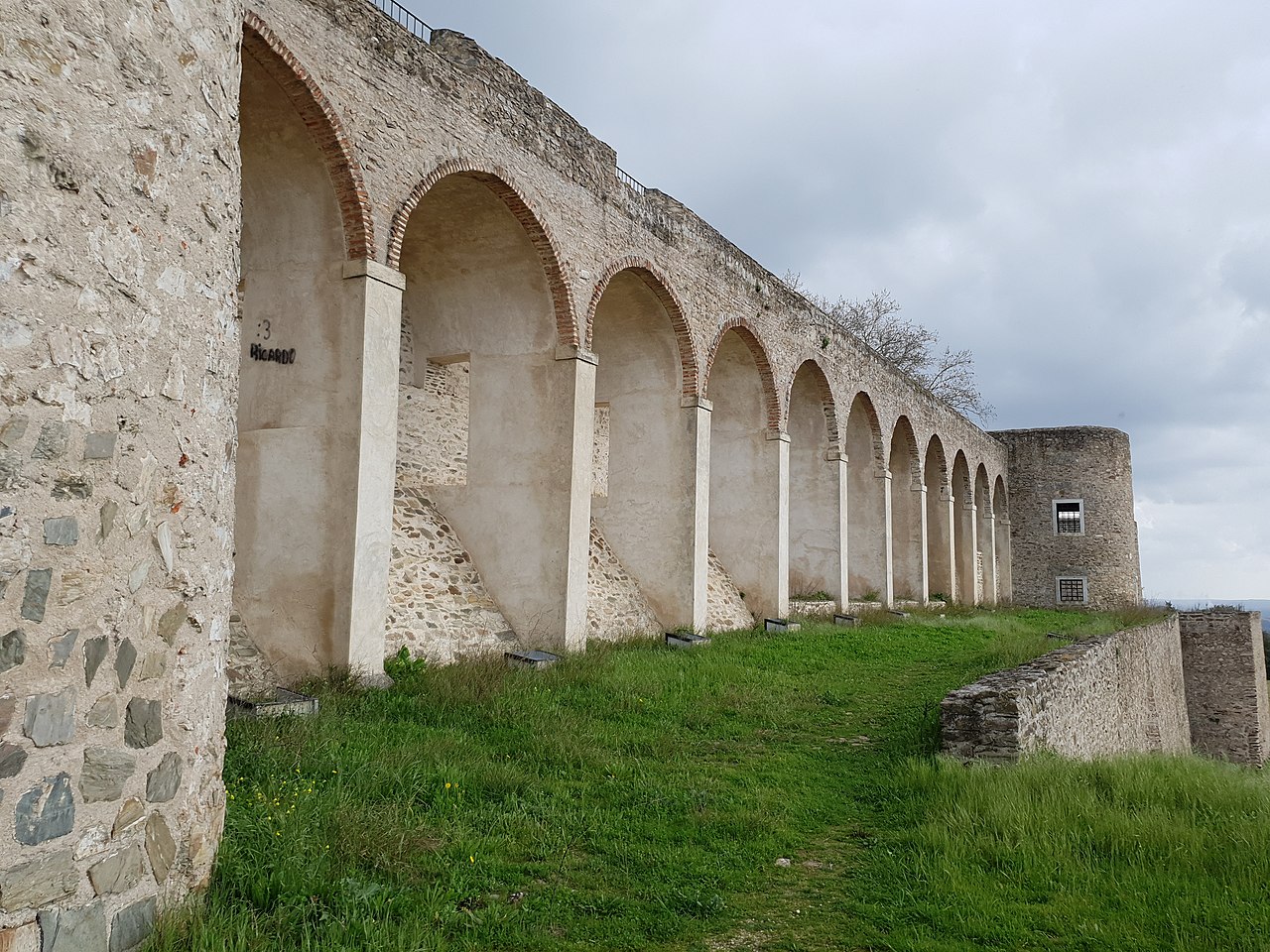 N° 03
N° 03© GualdimG · CC BY-SA 4.0 · Wikimedia Commons
Abrantes
ChapterA medieval hill town above the Tagus with a small hilltop castle, a tiny museum in the old church, and one of the great river views in central Portugal.
Duration
Half a day
For an afternoon of walking, and for the palha de Abrantes — a shockingly sweet local pastry of egg yolks and syrup.
 N° 04
N° 04© GualdimG · CC BY-SA 4.0 · Wikimedia Commons
Alpiarça
ChapterThe country house of José Relvas — statesman, art collector, agriculturalist — kept exactly as he left it in 1929. Persian carpets, tapestries, sculpture, and one of the finest private azulejo collections in Portugal.
Duration
2 hours
It is the most underrated small museum in the country.
Ask the guardian to show you the ornithological collection in the tower. He usually will.
 N° 05
N° 05© Alvesgaspar · CC BY-SA 4.0 · Wikimedia Commons
Santarém
ChapterThe old provincial capital, high on a bluff over the Tagus. A dozen medieval churches, a Moorish gate, and the panoramic Portas do Sol garden — a smaller, quieter cousin to Lisboa's.
Duration
Half a day
For the Portuguese Gothic. And for the view from Portas do Sol, which explains the whole province in one glance.
The Ribatejo's viewpoints are quieter than a miradouro in Lisboa — no crowds, no queues, no bougainvillea for the photographs. Just the river, the plain, and the long, low light of an inland country.

© Vitor Oliveira · CC BY-SA 2.0 · Wikimedia Commons
A garden built on the old Moorish citadel of Santarém, looking down over a wide bend of the Tagus. On a clear evening you can see the whole province from here — the wheat fields, the olive groves, the far edge of the Alentejo.

© Vitor Oliveira · CC BY-SA 2.0 · Wikimedia Commons
A hilltop chapel above the village of Constância. From the terrace you see the exact spot where the Zêzere meets the Tagus — one of the great small confluences in Iberia.

© GualdimG · CC BY-SA 4.0 · Wikimedia Commons
The old walls of the Abrantes castle look south over the Tagus. On a still evening in June, you can hear the storks call from the church tower two hundred metres below.
“Do not try to see everything. The Ribatejo teaches by omission.”
— Édi
The Ribatejo is a hands-in-the-earth country — wine, olive oil, the horse, the boat. These are four small ways to feel that up close.
 N° 01
N° 01© Alvesgaspar · CC BY-SA 4.0 · Wikimedia Commons
Castelo de Bode
ExperienceThe Zêzere is the cleanest river in Portugal, and the stretch above the Castelo de Bode dam is a green corridor of forest and cliffs. Rent a kayak from a small operator at Aldeia do Mato and paddle upstream.
Duration
Half a day
Because you will not hear a road, or another human being, for two hours. That is genuinely rare in Europe.
 N° 02
N° 02© Jules Verne Times Two (julesvernex2) · CC BY-SA 4.0 · Wikimedia Commons
Coruche
ExperienceRibatejano olive oil is one of Portugal's quietest exports. A small family lagar near Coruche will walk you through the harvest, the mill and the tasting — six oils, six different stories.
Duration
2 hours
You will taste why Portuguese olive oil is beginning to win the world's biggest competitions.
 N° 03
N° 03© Lynne Gerard · CC BY-SA 3.0 · Wikimedia Commons
Golegã
ExperienceA working Lusitano-horse farm near Golegã. Watch the training, meet the horses in their stalls, ride if you know how — or simply stand at the fence and understand why Portuguese horsemen have been famous since the Romans.
Duration
Half a day
The Lusitano is one of the world's great horse breeds. Meeting one in the field it was bred for is unforgettable.
We do not publish photographs of places we have not verified.
Ribatejo interior
ExperienceThe Ribatejo is one of the last places in Portugal where a handful of tiny producers still ferment wine in clay amphorae — the ancient Roman method. Small tastings can be arranged directly with the family.
Duration
2 hours
You will drink a wine that tastes like the year 200 AD.
Ask the winemaker to open the smallest amphora he owns. That is the one he drinks himself.
“The Ribatejo does not ask you to remember her. She just quietly waits.”
— Édi


