01
Wear comfortable shoes
Lisboa is stitched from calçada — small stones polished by centuries of feet. Beautiful, and merciless on heels.
Volume I · Lisboa
Ten chapters. One evening's read. Everything I would tell a friend arriving tomorrow.
Curated by Édi Cruz
Lisboa · 2026
I was born a short train ride from Lisboa, and I have spent most of my life walking her hills the way you would walk through a story — slowly, without a plan, letting one street lead to the next.
For years I have guided visitors around this country — friends, and friends of friends, and strangers who quickly became friends. What you are reading is not a directory. It is a page from a letter, handed to a friend. Nothing here is sponsored. Nothing here is booked. Every place I write about is somewhere I return to when I miss the city, or when I want a friend to feel it the way I do.
Portugal deserves your time. So please, take it.
For Portugal, with love.
This guide is free. Always.
None of these are rules, really. They are how the city rewards you if you let it.
Lisboa is stitched from calçada — small stones polished by centuries of feet. Beautiful, and merciless on heels.
The light before 9am belongs to bakers, fishermen and the old ladies watering geraniums. It is the truest Lisboa.
The city rewards the slow. A single square, if you sit long enough, will show you its whole day.
Any miradouro will do. The city turns copper, then rose, then the river disappears into itself.
Lisboa's hills are honest — they will tell you when they've won. A Bolt across town costs less than a coffee back home.
Not the postcard ones. The ones with a chalkboard, a football poster, and an old man who has been there since 7am.
You cannot see Lisboa fast. You can only see her at the pace of the woman two houses ahead hanging her laundry.
Skip the ones with photos on the menu. Trust the ones with paper tablecloths and a chalkboard.
Open the wrong door. Take the wrong tram. Ask a question in bad Portuguese. Every mistake here becomes a story.
Order a bica. Sit. Read the newspaper you can't understand. This is the assignment.
Every place here is somewhere I have eaten more times than I can count. Book ahead when you can. Bring cash for the small ones.
 N° 01
N° 01© Kritzolina · CC BY-SA 4.0 · Wikimedia Commons
A tiny room at the top of a staircase where the octopus rice is the reason and the welcome is the memory.
Price
€€
Best time
Lunch, 1pm — 2:30pm
Duration
About 90 minutes
Family-run, low ceilings, football on a small television nobody is watching.
Because the owner will tell you what to order and she will be right. I have never left with anything other than a full stomach and a soft heart.
We do not publish photographs of places we have not verified.
The kind of place your grandmother would have taken you to, if your grandmother happened to be Portuguese and a very good cook.
Price
€
Best time
Weekday lunch — noon to 2pm
Duration
About an hour
Old tiles, plastic chairs, an entire neighbourhood at lunch. No English menu — and it doesn't matter.
I take everyone I love here. It stays the same year after year and that is its whole magic.
 N° 03
N° 03© The Ogre · CC BY-SA 4.0 · Wikimedia Commons
Petiscos with a young, gentle hand. A younger kitchen with an old memory.
Price
€€
Best time
Dinner, first sitting at 7pm
Duration
1½ to 2 hours
A dozen seats, an open kitchen, a chalkboard that changes with the day and the fisherman.
It's small so you'll need to book. Ask for the wine the waiter is drinking — that is the only correct choice.
 N° 04
N° 04© Fpenteado · CC BY-SA 3.0 · Wikimedia Commons
Two people, one kitchen, a menu that reads like a love note to Portuguese classics.
Price
€€
Best time
Dinner, after 8pm
Duration
About 2 hours
Warm lamps, a handful of tables, always a small line of locals outside — a good sign anywhere in the world.
For the pudding alone. But stay for the way they thank you when you leave.
 N° 05
N° 05© Dolon Prova · CC BY-SA 4.0 · Wikimedia Commons
Mouraria's most honest tasca. Grilled meat, tiled walls, and a queue that never really goes away.
Price
€
Best time
Lunch — arrive before 12:30pm or expect a queue
Duration
About an hour
Loud, smoky, joyful. You will share your table with strangers and leave with a friend.
It's the closest thing to eating in a Portuguese home without knocking on a door.
“The simplest restaurants usually serve the best food.”
— Édi
A small custard tart, still warm, with a dusting of cinnamon. There is no wrong answer here, only better ones.

© MollySVH · CC BY 2.0 · Wikimedia Commons
Warm from the oven, still trembling. The cream is deep and lightly burnt on top. Order two. You will regret ordering only one — I always do.
© Prainsack Josef · CC BY-SA 3.0 · Wikimedia Commons
The original recipe from 1837. The queue is long; skip it and eat inside at the counter. Blue and white azulejos, a dusting of cinnamon, and something that tastes older than you.

© Juan Antonio F. Segal · CC BY 2.0 · Wikimedia Commons
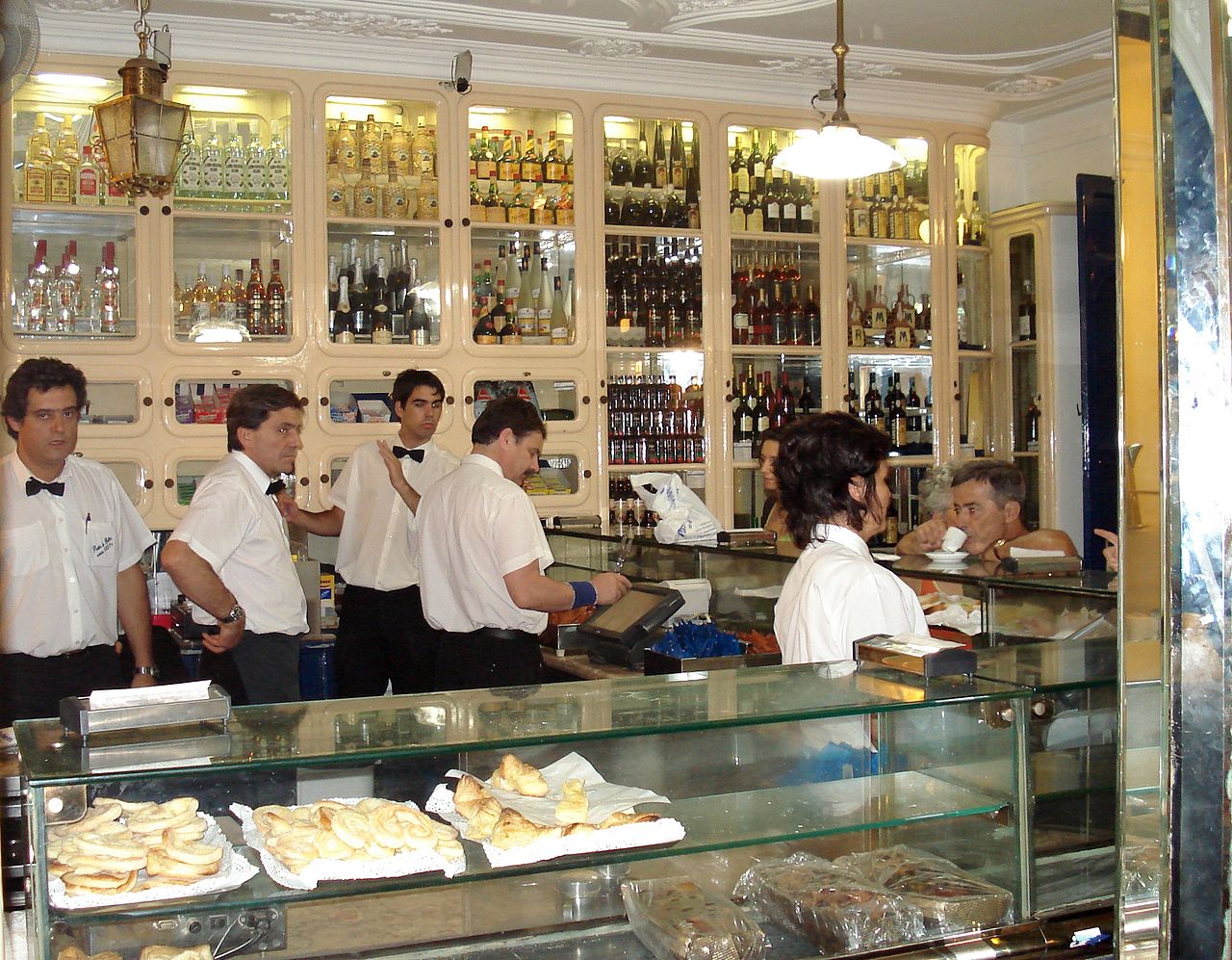
Since 1829. Come for the pastel, stay for the marble counter and the small ceremony of a coffee taken standing up, elbow to elbow with a lisboeta on his way to work.

© F Delventhal · CC BY 2.0 · Wikimedia Commons
You can watch them made through the glass. A little more theatre than tradition, but the pastry is faultless and the cinnamon is generous. Good for a quick, warm stop between hills.
“A pastel de nata is always better than the one before it.”
— Édi
Lisboa is a city built to be looked at from above. Every neighbourhood has its balcony. These are the four I return to most.

© Vitor Oliveira · CC BY-SA 2.0 · Wikimedia Commons
The highest of them all, and, for that reason, the quietest. There is a small chapel, a pine tree, and a bench that always seems to be waiting for you.

© Ricardo Resende · CC BY-SA 4.0 · Wikimedia Commons
Bougainvillea on a pergola, a wall of blue azulejos, and Alfama pouring down toward the river like a spilled drink.

© Wikimedia contributor · CC BY-SA 4.0 · Wikimedia Commons
Perhaps the most photographed balcony in the city — and yet, at sunrise, it can be entirely yours.

© Carlos Luis M C da Cruz · Public domain · Wikimedia Commons
Not a miradouro in the classical sense, but a long, low horizon of river and monuments. Start at the Torre and drift east until your legs are tired.
“If I only had one free afternoon in Lisboa, I would come here.”
— Édi
Lisboa keeps its treasures behind ordinary doors. These are the rooms I would send a friend to on a quiet morning.
 N° 01
N° 01© Vitor Oliveira · CC BY-SA 2.0 · Wikimedia Commons
Housed in a former 16th-century convent, this museum traces five centuries of Portuguese tile-making — from Moorish geometry to modernist murals.
Duration
Allow 90 minutes
It is the quietest museum in Lisboa and, I would argue, the most Portuguese one.
Walk to the top floor for the 23-metre panel of pre-1755 Lisboa — a hand-painted panorama of the city that no longer exists.
 N° 02
N° 02© Alvesgaspar · CC BY-SA 3.0 · Wikimedia Commons
The private collection of Calouste Gulbenkian — Egyptian gold, Islamic ceramics, Lalique glass, a Rembrandt or two — held together by a garden that alone justifies the visit.
Duration
Half a day, at least
Because the garden alone is worth the trip. Bring a book. Stay a whole afternoon.
Behind the main museum, the modern art wing has a lily pond café — Portuguese architects come here to think.
 N° 03
N° 03© LightWord · CC0 · Wikimedia Commons
A Moorish-style palace hidden behind an ordinary door on Rua das Portas de Santo Antão. Open the door and step into another country.
Duration
30 minutes to wander, longer if you eat
For the courtyard. For the tiled ballroom. For the surprise.
Climb the staircase to the first floor — the neo-Arabian dining room is free to walk through, even if you're not eating.
 N° 04
N° 04© Jules Verne Times Two · CC BY-SA 4.0 · Wikimedia Commons
The Ribeiro da Cunha Palace — a Neo-Moorish jewel built in 1877, now home to Portuguese designers, jewellers and a gin bar in the courtyard.
Duration
About an hour
For an hour of shopping at a walking pace, in the most beautiful hallway in Lisboa.
Look up. The stained-glass skylight above the central hall is worth the visit even if you buy nothing.
 N° 05
N° 05© Bex Walton · CC BY 2.0 · Wikimedia Commons
An old industrial complex under the 25 de Abril bridge, reborn as a cluster of studios, bookshops and small restaurants.
Duration
2 to 3 hours
For Ler Devagar — the bookshop with a printing press and a bicycle in mid-flight from the ceiling.
Sunday brings a small flea market on the main courtyard. Come around 11am, when the crates are still full.
 N° 06
N° 06© Vitor Oliveira · CC BY-SA 2.0 · Wikimedia Commons
An old munitions factory turned cultural house — concerts, poetry, exhibitions, a bar that stays open long after most of the city has slept.
Duration
An evening
Because it does not care whether you find it. And that is exactly why you should.
There is a small library on the first floor. You are welcome to sit and read as long as you like.
 N° 07
N° 07© Vitor Oliveira · CC BY-SA 2.0 · Wikimedia Commons
The riverside district that Lisboa is still writing. Wine cellars, craft breweries, galleries in old warehouses.
Duration
An afternoon
For an afternoon that feels like you found the city before anyone else.
Come on a Saturday — most cellars open only from Friday afternoon through Sunday evening.
 N° 08
N° 08© Sonse · CC BY 2.0 · Wikimedia Commons
The old Mercado da Ribeira, curated by the food writers of Time Out. A snapshot of the city's chefs under one roof.
Duration
1 to 2 hours
Good if you have little time and many appetites. Go outside peak hours or you will not find a seat.
The old market half — with the flowers and the fish — is still there behind the food hall, and quieter.
One room in Lisboa that I mention only to people I really like.
 N° 01
N° 01© Adriao · CC BY-SA 3.0 · Wikimedia Commons
In a quiet convent in the hills of Lisboa, a handful of sisters cook a simple homemade lunch — a soup, a main, a small dessert. There is no menu. You eat whatever they made that morning.
A garden view. One of the most surprising panoramas in the city (I won't describe it — it's better as a surprise).
Lunch only. Bring cash. Speak softly. Thank them twice.
The nuns are too busy praying in the evening.
Fado is not a performance. It is a room, a bottle of wine and a voice that tells you the truth. There are two ways to hear it — neither is wrong. They are simply different evenings.
 N° 01
N° 01© Vitor Oliveira · CC BY-SA 2.0 · Wikimedia Commons
You reserve a table, you eat without hurrying, you drink a little more than you meant to, and around 9pm the lights dim and someone begins to sing about something you may not entirely understand — but you will feel every word.
First time in Lisboa. A long, unhurried evening. Bringing someone you love.
Small houses in Alfama or Mouraria. Book a week ahead. Avoid the big tourist rooms.
 N° 02
N° 02© 69joehawkins · CC BY-SA 3.0 · Wikimedia Commons
Later at night, in a smaller room, a glass of wine in your hand, no plates on the table. This is fado vadio — anyone in the room might rise and sing.
Your second or third night. A quieter, more local evening. Solo travellers.
Late start (10pm or later). Do not applaud during the songs — only after.
You are never more than an hour from the ocean. Pick a day, pick a train, and remember a towel.

© Sonse · CC BY 2.0 · Wikimedia Commons
A wide, soft beach half an hour from the city by train. Surfers in the morning, families by lunch, students at sunset.
WhoA quick, easy escape from the city with no car needed.
SeasonMay — October

© José Carlos Cortizo Pérez · CC BY 2.0 · Wikimedia Commons
Wild, windswept, dramatic. The Atlantic here does not pretend to be gentle. Pine forest at your back, the Serra de Sintra on the horizon.
WhoKite-surfers, photographers, and anyone who prefers weather to sunbathing.
SeasonBeautiful year-round; best in autumn

© Osvaldo Gago (Wikimedia Commons) · CC BY-SA 3.0 · Wikimedia Commons
Kilometres of sand on the south bank of the Tejo. A little bus called the transpraia takes you further along to quieter stretches.
WhoLong walks. Grilled fish at a beach shack. A whole day without a plan.
SeasonJune — September

© Vitor Oliveira · CC BY-SA 2.0 · Wikimedia Commons
A small seaside village beyond Sintra with a river running into the sea. The old tram still rattles down to the beach in summer.
WhoA late lunch of grilled sardines with a view of the Atlantic.
SeasonJuly — September
“The river answers everything, eventually.”
— Édi