01
Three villages, one name
Praia (the seafront), Sítio (the cliff-top with the sanctuary), Pederneira (the old hill town). The funicular connects Praia to Sítio in three minutes.
Volume X · Nazaré
Fishermen who still salt cod on the beach, a chapel where a knight was saved, and the largest wave ever surfed.
Curated by Édi Cruz
Nazaré · 2026
The story goes like this: in 1182, a Portuguese knight named Dom Fuas Roupinho was hunting on the cliff at Sítio da Nazaré when the fog closed in. His horse charged towards the edge. He called out to Our Lady of Nazaré — and the horse stopped, hooves on the rim of the two-hundred-metre drop.
That is why the chapel is where it is. And that is why every fisherwoman here still wears seven skirts — one for each wave of the sea, one for each day of the week, one for good luck. Nazaré's traditions are older than most nations.
Come in November for the giant waves at Praia do Norte. Come in July for the sardines. Come in September for the pilgrimage. Come whenever — Nazaré will be doing what Nazaré has always done.
For Portugal, with love.
This guide is free. Always.
Nazaré has three parts. Do not confuse them.
Praia (the seafront), Sítio (the cliff-top with the sanctuary), Pederneira (the old hill town). The funicular connects Praia to Sítio in three minutes.
The Mercado Municipal has a large lot. From there everything is on foot — Praia is flat, Sítio is up.
The giants only arrive in winter, born by the underwater Nazaré Canyon. Summer is calm, family beach weather.
The auction at the Docapesca ends around three. The best restaurants have their catch on the grill by four.
The seven-skirt tradition is living, not a costume. A quiet 'posso?' and a smile are enough — most will nod.
A soft glazed bun with a custard heart. Every pastelaria on Avenida da República makes them. Two euros, hot from the oven.
Walk out to Forte de São Miguel Arcanjo an hour before sunset. If the sea is angry, this is where you'll see the giants.
Nazaré's kitchen is the sea. Sardines in July, robalo year-round, and caldeirada de peixe if there is a wedding.
 N° 01
N° 01© Yusuke Kawasaki · CC BY 2.0 · Wikimedia Commons
A working-class marisqueira three blocks from the beach. Grilled sardines, potatoes, a green salad, house wine. Under 15 euros. Loud, honest, always full at 8pm.
 N° 02
N° 02© GualdimG · CC BY-SA 4.0 · Wikimedia Commons
The town's covered market — fishmongers on the ground floor, small tascas upstairs where the fishmongers eat lunch. Open 7am to 1pm, Tuesday to Sunday. Bring a basket.
“The seven skirts are not a costume. They are a calendar.”
— Édi
Sítio is Nazaré's holy quarter. Two churches, one bandstand, and the story of Dom Fuas.
 N° 01
N° 01© Vitor Oliveira · CC BY-SA 2.0 · Wikimedia Commons
The 14th-century sanctuary where the fisherwomen come to give thanks when the men return alive. Blue-and-white azulejos inside, silver ex-votos on the walls — tiny cast boats, hearts, hands. Free to enter. Bring a coin for a candle.
 N° 02
N° 02© Joseolgon · CC BY-SA 4.0 · Wikimedia Commons
The coreto (bandstand) in the square in front of the sanctuary was the summer music room of the Portuguese royal family. The palace behind it, D. Manuel II's summer residence, is now a small museum. Both quiet, both free.
In winter the biggest waves ever surfed break here. The fort is the only safe place to watch.
 N° 01
N° 01© Carjormartin · CC BY-SA 4.0 · Wikimedia Commons
The 17th-century sea fort at the north end of Sítio, converted to a lighthouse in 1903 — now the world's most famous big-wave viewpoint. On a good day in December, you will see 20-metre walls of water and a single surfer on a tow-in board. Two euros to enter.
 N° 02
N° 02© Luís Ascenso · CC BY 3.0 · Wikimedia Commons
This is why they come. The underwater Nazaré Canyon focuses North Atlantic swells into single monster waves — the record is 30 metres, set here in 2020. Watch from the fort. Never from the sand.
Two beaches, one village. One for children. One for legends.
 N° 01
N° 01© Palickap · CC BY-SA 4.0 · Wikimedia Commons
The wide, safe crescent that gave the town its name. Calm in summer, lifeguards from June to September, striped tents (barracas de praia) rented from the fishermen's families. Two kilometres of soft sand, one kilometre of restaurants.
 N° 02
N° 02© Addshore · CC BY-SA 3.0 · Wikimedia Commons
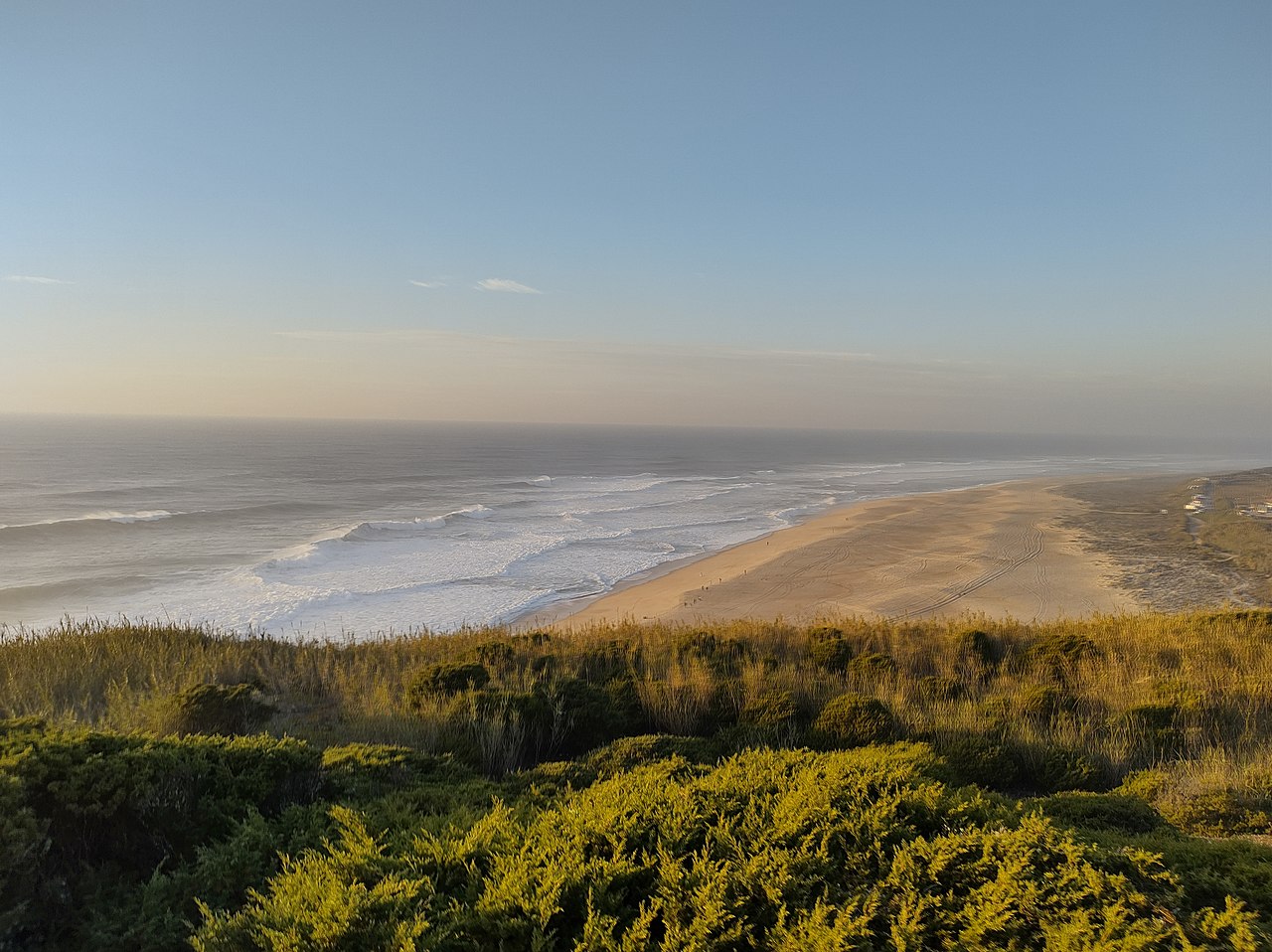
In the calm months (June–September) the same beach that hosts the giants becomes a wide, wild, dark-sand walk. Windy, deserted, better for photographs than for swimming. Walk out at low tide, back before dark.


